A Gentle Practice: Five Small Experiments to Sharpen and Care for Kitchen Knives
Keeping kitchen knives sharp is less a single heroic act than a calm, repeatable practice. This article offers five short experiments — each 10–20 minutes — that build a reliable skill set. For each experiment you’ll find a clear objective, a simple procedure, and a short checklist of common mistakes with practical corrections.
Experiment 1 — Learn to Read an Edge
Objective: Recognize when a blade needs attention and what kind of attention it needs.
- Do: Wash and dry a knife. Hold it under good light and look along the edge from heel to tip.
- Try: Gently run a finger (perpendicular to the edge, never along it) to feel for burrs or unevenness.
Common mistakes and corrections:
- Mistake: Running a fingertip along the edge. Correction: Move perpendicular to the edge to avoid cuts.
- Mistake: Deciding only by slicing paper. Correction: Combine visual inspection, a perpendicular touch test, and a light paper test.
Experiment 2 — Daily Honing with a Steel or Ceramic Rod
Objective: Learn a safe, repeatable honing stroke to realign a blade between sharpenings.
- Setup: Hold the rod vertically with its tip on a folded towel. Grip the knife and place the heel on the rod at a 15–20° angle.
- Step: Sweep the blade from heel to tip, moving down the rod so the whole edge contacts the rod. Repeat 5 times per side.
Common mistakes and corrections:
- Mistake: Using the wrong angle. Correction: Aim for 15–20° for most kitchen knives; imagine slicing a thin piece off the rod.
- Mistake: Pressing hard. Correction: Use light, controlled strokes — the goal is alignment, not metal removal.
Experiment 3 — Try a Pull-Through Sharpener Carefully
Objective: Understand what a pull-through tool does and when it’s appropriate.
- Step: Place a small pull-through sharpener on a stable surface. Pull the knife through once or twice, using even pressure.
- Observe: Note how it feels compared with honing with a rod.
Common mistakes and corrections:
- Mistake: Repeatedly dragging the blade with heavy force. Correction: Use only a couple of smooth pulls; repeated, heavy use removes more metal and shortens the blade’s life.
- Mistake: Using on fine filleting or Japanese knives without checking compatibility. Correction: Test on an inexpensive knife first; some tools are too coarse for delicate edges.
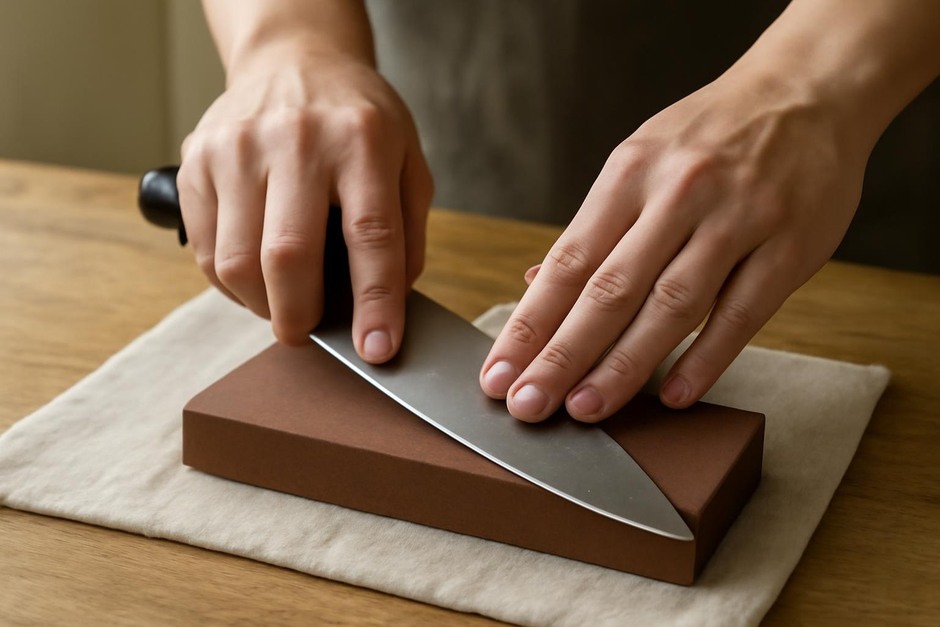
Experiment 4 — Basic Whetstone Practice
Objective: Learn a single, repeatable stroking motion on a coarse and then a fine stone.
- Prep: Soak a 1000-grit stone if required, place on a non-slip mat. Hold the knife at 15–20° and draw the edge across the stone from heel to tip, maintaining the angle.
- Routine: Five strokes on the coarse side per side, then five on a 3000–6000 grit for finishing. Check for a burr and remove it with light strokes or a strop.
Common mistakes and corrections:
- Mistake: Changing angle mid-stroke. Correction: Move the whole knife so the angle is steady; slow down and count strokes.
- Mistake: Skipping burr removal. Correction: Finish with stropping or light honing to take off the wire edge for a clean cut.
Experiment 5 — Care, Storage, and a Weekly Routine
Objective: Build habits that extend the life of a sharp edge.
- Weekly checklist:
- Hone before each heavy use (few strokes on a rod).
- Sharpen on a stone when the blade resists or tears food (every few months for regular home use).
- Clean, dry, and store knives in a wooden block, magnetic strip, or sheath to avoid edge contact.
Common mistakes and corrections:
- Mistake: Leaving knives in a sink or damp drawer. Correction: Wipe and dry immediately to prevent corrosion and chipping.
- Mistake: Using a cutting board that’s too hard (glass, stone). Correction: Use wood or plastic cutting boards to protect the edge.
Closing Practice
Over the next three weeks, try each experiment once per week and the weekly routine every few days. Keep a small notebook: note what felt different, one mistake you made, and the correction you used. This gentle, observational approach turns sharpening from a chore into a quiet skill that keeps your knives working well and your kitchen calmer.